
Term Life vs ULIP vs Endowment: Which Insurance Plan Is Right for You?
Walk into any bank or insurance office in India and you'll be pitched one of three products: a Term plan, a ULIP, or an Endowment / Money-Back policy. They all have the words "life insurance" on the brochure, but they are radically different financial instruments — and most people end up with the wrong one.
Here's a transparent, side-by-side comparison so you can decide based on facts instead of the agent's commission.
The Three Plans At A Glance
| Feature | Term Life Insurance | ULIP | Endowment / Money-Back |
|---|---|---|---|
| Primary purpose | Pure life protection | Insurance + market-linked investment | Insurance + low-yield savings |
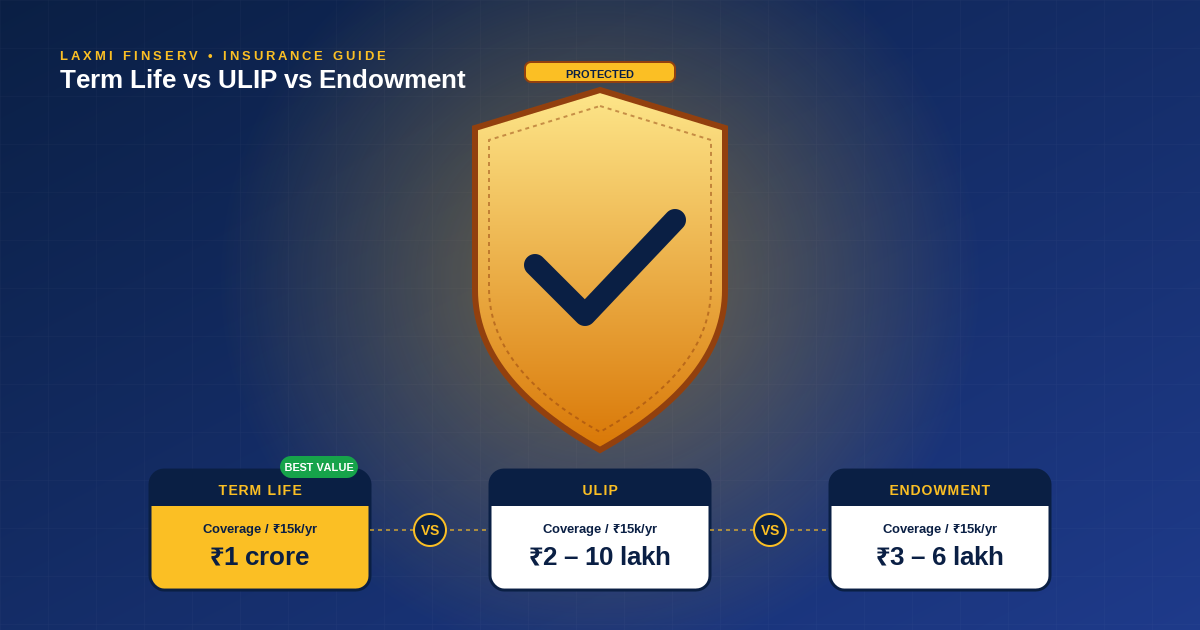
| Coverage for ₹15,000/yr premium (age 30) | ₹1 crore – ₹1.5 crore | ₹2 lakh – ₹10 lakh | ₹3 lakh – ₹6 lakh |
| Maturity benefit if you survive | None (premium expires) | Fund value at maturity | Sum assured + bonus |
| Expected return (CAGR) | Not applicable | 8% – 12% (market-linked) | 4% – 5.5% |
| Charges / commissions | Lowest (5–10% of premium) | Premium allocation, mortality, fund-management charges | High commissions (20–35% of year-1 premium) |
| Lock-in | None — exit anytime | 5 years | Effectively till maturity (15–25 yrs) |
| Liquidity | None | Partial after 5 years | Surrender penalty up to 70% in early years |
| Best for | Anyone with dependents | Disciplined long-term investors comfortable with markets | People who want guaranteed (low) returns + insurance |
1. Term Insurance — The Most Honest Product in Indian Insurance
A term plan is pure life cover. You pay a small premium, and if you die during the policy term, your nominee gets a large lump sum (the sum assured). If you survive, you get nothing back — and that's exactly the point.
Why it wins on protection: a 30-year-old non-smoker can buy ₹1 crore of cover for around ₹12,000–₹15,000 per year. The same premium in a ULIP gets you maybe ₹10 lakh of cover. The economics aren't even close.
Rule of thumb: your life cover should be 10× to 15× of your annual income. Term insurance is the only product that makes that affordable.
2. ULIPs — Insurance With An Investment Strapped On
A Unit-Linked Insurance Plan combines life cover with a mutual-fund-style investment account. You can choose equity, debt, or balanced funds inside the policy.
Strengths: single product for cover + investment, market-linked returns, fund-switching is tax-free inside the policy, and the entire maturity proceeds can be tax-free under section 10(10D) if the annual premium is ≤ 2.5 lakh.
Weaknesses: you pay 4-5 layers of charges in the early years which significantly drag down returns. 5-year lock-in. Cover is usually low compared to a separate term plan.
3. Endowment / Money-Back — The Lowest-Return Trap
These traditional plans guarantee a fixed sum at maturity plus bonuses. They feel "safe", which is why your bank's relationship manager pushes them so hard.
The reality: the actual long-term return is typically 4–5.5% per year, which barely beats inflation. The cover provided is laughably low for the premium paid. Surrendering early loses you 30–70% of premiums paid.
If a financial product takes 25 years to grow your money 2.5×, you'd have done significantly better with a PPF + term plan combination.
The Right Combination For Most Indians
- Buy a pure term plan for 15-20× your annual income. ₹1 crore cover for ₹12-15k/year is a no-brainer.
- Invest the difference in ELSS mutual funds (for tax saving) and an SIP in diversified equity funds (for growth).
- Top up with health insurance separately — life and health cover should never be bundled.
This "buy term, invest the rest" approach gives you significantly higher cover, better returns, and total flexibility — instead of getting locked into a single high-cost product for 20 years.
Confused which option fits your specific income, age, and family situation? Get a free 30-minute review with our IRDA-certified advisors — we'll show you the exact cover-to-premium ratio you should be paying and flag any existing policies that may be silently underperforming.