
Smart Tax Planning Strategies for Salaried Employees in India (2026 Guide)
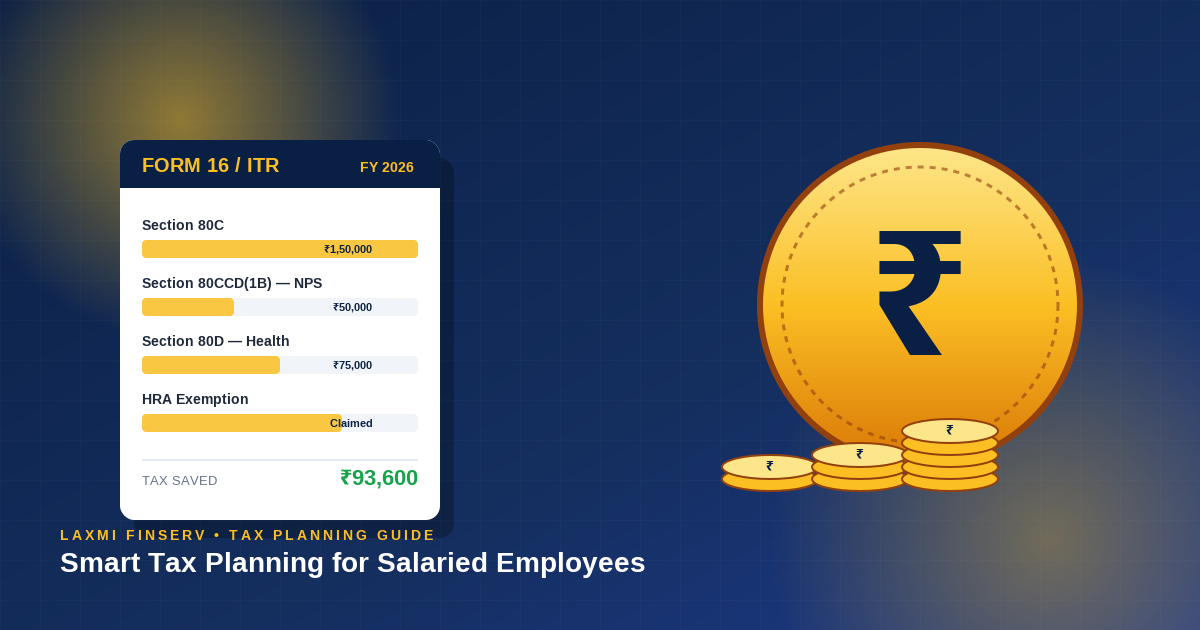
Filing your income tax return only at the last minute? You're leaving real money on the table. With the right tax-planning strategy spread across the financial year, a salaried employee in India can comfortably reduce their taxable income by ₹1.5 lakh to ₹2.5 lakh — without a single rupee of grey-area accounting.
This guide breaks down the most powerful, fully legal tax-saving avenues available to salaried professionals in 2026, ordered from highest impact to nice-to-have.
1. Section 80C — The ₹1.5 Lakh Foundation
Section 80C is every salaried taxpayer's primary lever. The combined deduction across the following instruments is capped at ₹1,50,000 per financial year:
- Employee Provident Fund (EPF) — your monthly contribution counts automatically.
- Public Provident Fund (PPF) — 15-year lock-in, currently around 7.1% tax-free returns.
- Equity-Linked Savings Scheme (ELSS) Mutual Funds — only 3-year lock-in and historically the highest-returning 80C option.
- Life insurance premiums — for self, spouse, or children.
- Home loan principal repayment.
- Tuition fees for up to 2 children.
- 5-year tax-saving Fixed Deposits, NSC, Sukanya Samriddhi for those with daughters.
Don't spread money thinly across all of these. Pick one growth option (ELSS) and one safe option (PPF / EPF) and stick to them.
2. Section 80CCD(1B) — An Extra ₹50,000 with NPS
The National Pension System gives you an additional ₹50,000 deduction over and above the ₹1.5 lakh 80C limit. That alone can save you ₹15,600 in taxes if you're in the 30% slab. Most salaried professionals miss this entirely.
3. Health Insurance — Section 80D
- Up to ₹25,000 for premium paid for self, spouse, and children
- Additional ₹50,000 if you also pay premium for senior-citizen parents
- Up to ₹5,000 for preventive health check-ups (within the above limits)
If you're paying ₹30,000+ a year on family health cover and didn't claim 80D, you're effectively donating to the tax department.
4. House Rent Allowance (HRA) — Often Under-Claimed
If you live in rented accommodation and your salary structure includes HRA, you can claim the lowest of:
- Actual HRA received
- 50% of basic salary (metro cities) or 40% (non-metro)
- Rent paid minus 10% of basic salary
Submit rent receipts and your landlord's PAN if annual rent exceeds ₹1 lakh.
5. Home Loan Benefits — Two Sections, Two Pots
- Section 24(b) — interest paid on a self-occupied home loan, deductible up to ₹2,00,000 per year.
- Section 80C — principal repayment is part of the 1.5 lakh basket.
- For first-time buyers, Section 80EEA may give an additional ₹1.5 lakh deduction (subject to property value rules).
6. Old Regime vs New Regime — Don't Auto-Pilot
The new regime offers lower slab rates but strips most deductions. Run both calculations every year. As a rule of thumb: if your eligible deductions (80C + 80D + HRA + home loan interest) exceed roughly ₹3.5 lakh, the old regime usually still wins.
The Bottom Line
Tax planning is best done at the start of the financial year, not the last week of March. A salaried professional who systematically uses 80C + 80CCD(1B) + 80D + HRA can reduce their tax outgo by ₹70,000-₹1,00,000 every year — money that compounds in your name, not the government's.
Need a tax-planning blueprint customized to your salary structure? Book a free consultation with our certified advisors and walk away with a one-page plan showing exactly which sections to claim, how much each will save, and the proof documents to keep.